S2, E5: The Woman on Every Billboard: The Shocking Julia Reagan Story
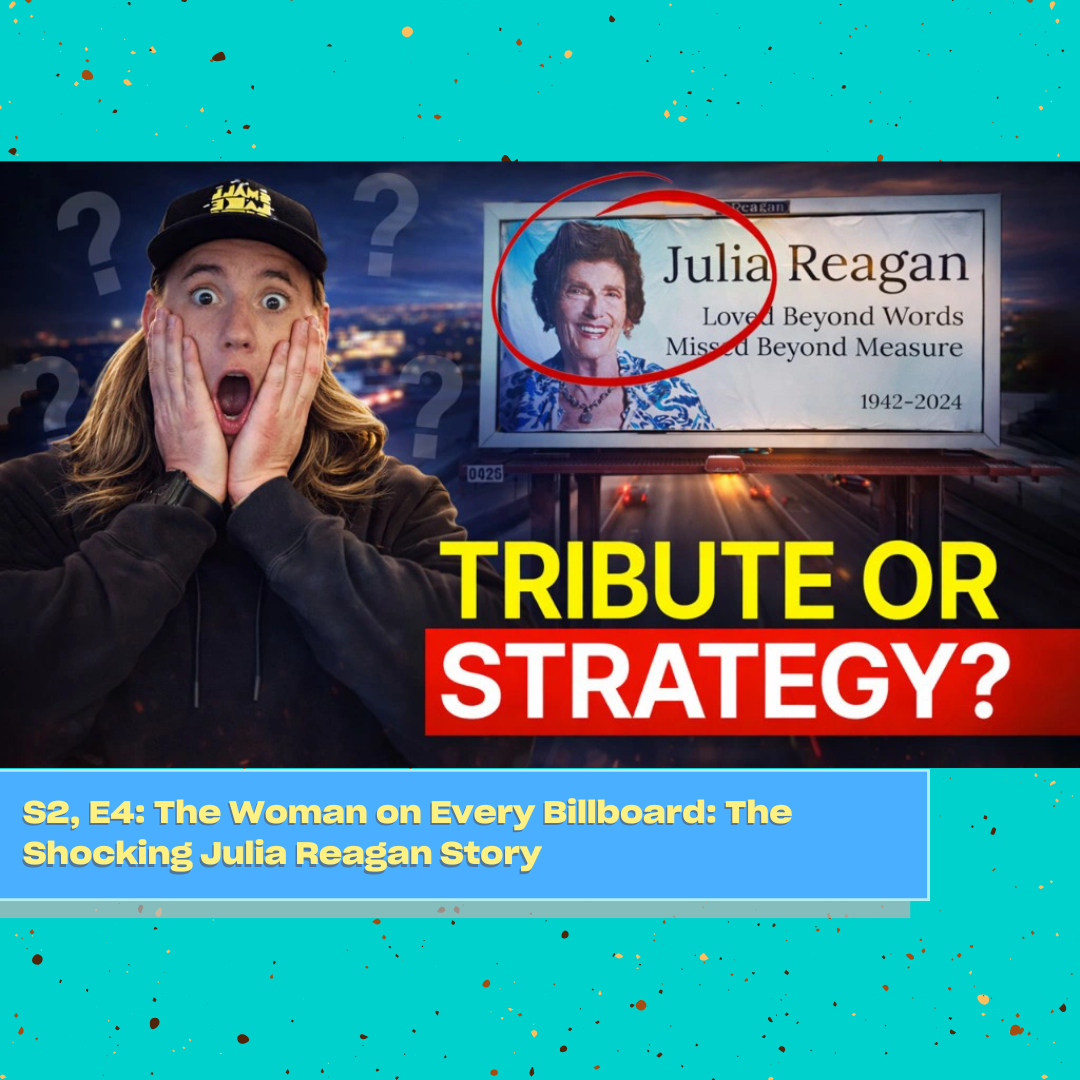
The image was simple: a bright portrait and a line that read In loving memory of Julia Reagan. Yet motorists across Utah and far beyond could not escape it, and that ubiquity turned a private loss into a public riddle. Most memorial billboards last a week or two, tied to a date or a fundraiser, but this wave felt different. It spread across multiple states, lingered, and offered no URL or campaign. That silence invited speculation. Curiosity fed the algorithm, and soon social media pushed the question everywhere: who was she, and why was she on so many signs? To answer that, we have to look at Utah, at power, and at the thin line where remembrance meets media strategy.
Julia Reagan was not a household name. Her husband, Bill Reagan, owns Reagan Outdoor Advertising, a dominant force in Utah’s skyline and a major player in other states. When a family with access to one of the largest out-of-home networks decides to grieve publicly, the scale looks different. What might have been a local tribute became national visibility because the infrastructure already existed. You did not need to know the company to feel the effect. Drivers recognized the image before they knew the story, and that order mattered. First came emotion; only later came context. That dynamic is the essence of brand architecture and narrative framing: the image establishes familiarity, then meaning attaches after repetition.
Reports indicate that before her death, Julia sought care at renowned institutions, including the Mayo Clinic in Arizona. According to a later wrongful death lawsuit, she returned to Utah and was admitted to University of Utah Hospital, where, the complaint alleges, preventable missteps led to aspiration, severe injury, and cardiac arrest. These claims remain unproven and will be tested in court, but their existence reframes the billboards. Once the lawsuit became public, people reinterpreted the memorial as more than grief. Visibility can be memory, but it can also be leverage. Reputation pressure influences institutions, sways juries indirectly through culture, and primes public sentiment. In high-stakes litigation, narrative is a tool, and out-of-home media is narrative at scale.
Still, reducing the billboards to strategy alone misses the human core. Grief is disruptive, and people mourn in the languages they know. For a billboard family, the skyline is a scrapbook. A portrait on I‑15 is a candle on the mantle, multiplied a thousandfold. That’s why the creative remained stark: no call to action, no accusations, no ask. A spare line kept the message inside memorial norms while letting the mystery do the heavy lifting. Minimalism generated conversation without crossing into advocacy, a subtle balance that amplified attention while avoiding legal pitfalls. The lack of detail prevented immediate polarization and kept the focus on a face, not a brief.
The campaign’s cadence added another layer. After the initial surge, the family signaled a plan to return each year around Memorial Day, transforming the tribute into ritual. Rituals anchor memory and renew public awareness on a predictable cycle, which is exactly how brands stay salient. In marketing terms, it’s reach and frequency; in human terms, it’s remembrance. The effect on search behavior, local news coverage, and social chatter compounds each year, ensuring the name remains indexed in both algorithms and communities. Whether or not that helps a legal case, it undeniably shapes the cultural context in which the case lives.
What, then, should we take from this? First, out-of-home advertising remains the most public canvas for storytelling, and when used without a product or URL, it becomes a cultural mirror. Second, institutions and individuals now share the same media field, which means private loss can become public narrative overnight. Third, two truths can coexist: a husband can honor his wife and understand the strategic implications of scale. The ethical line is not whether grief is visible but whether visibility manipulates facts. Here, the facts will be argued in court; the billboards simply ensured the story would be seen, felt, and remembered.
Listen to full episode :