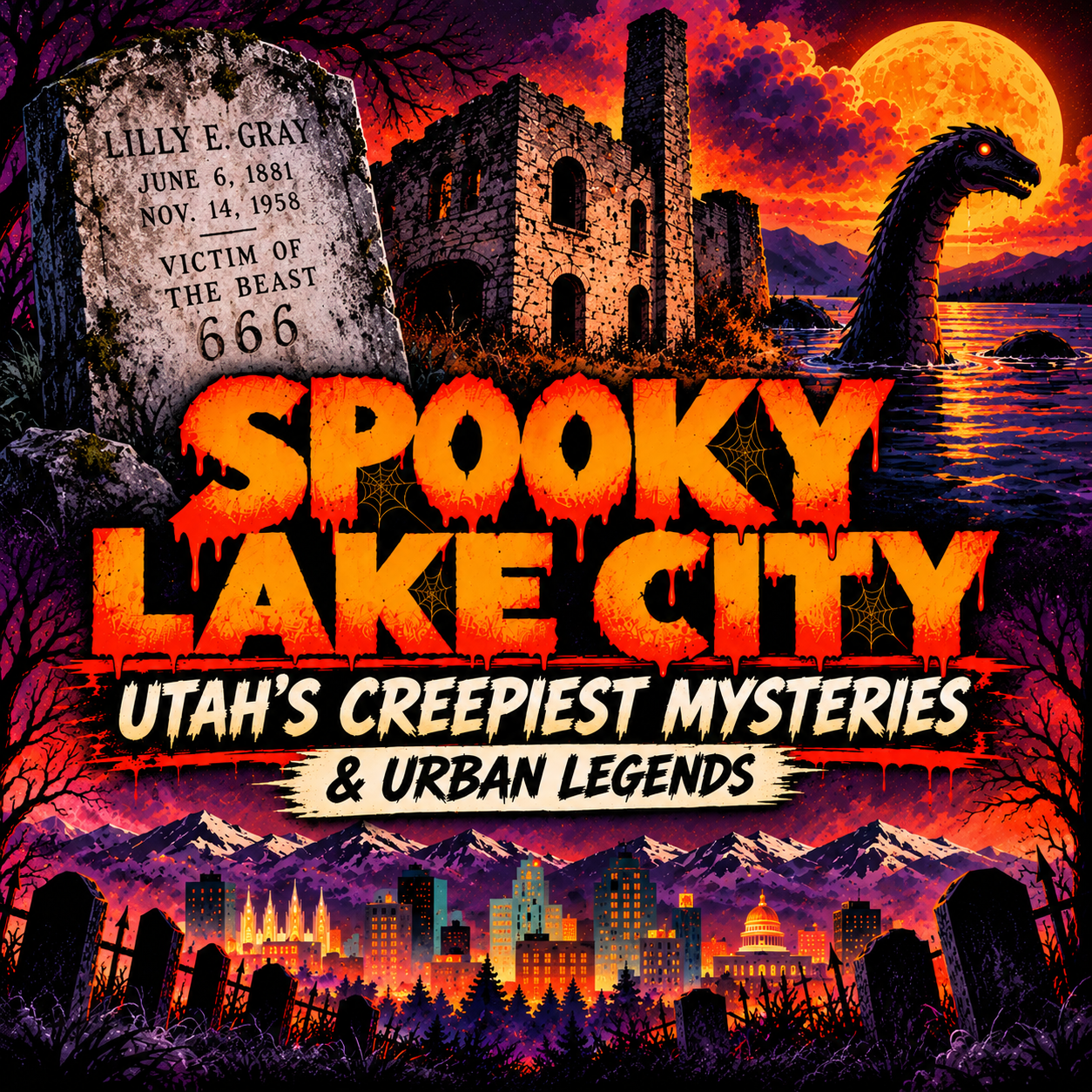
Salt Lake City legends hit differently when you can point to a real place on a map and say, “It’s right there.” This episode follows that exact trail through Utah folklore, haunted history, and the kind of spooky stories that spread at sleepovers and linger for generations. We start in the Salt Lake City Cemetery with one of the most photographed graves in town: Lily E. Gray, whose headstone reads “Victim of the Beast 666.” Internet theories love the satanic angle, the highway 666 angle, the curse angle, but the more grounded truth is sharper. Records paint Lily as ordinary, while her husband Elmer Gray looks like the source of the inscription, framing “the beast” as government and law enforcement. It’s a reminder that true crime, paranoia, and grief can leave marks that outlive a person.
The cemetery stories keep coming with “Emo’s Grave,” a classic Salt Lake City ghost tale: light a candle, circle a small tomb, chant a name, and supposedly you’ll see glowing red eyes. The detail that flips the story is almost comedic: the name “Emo” is not on the tomb at all. The monument belongs to Jacob Moritz, a German immigrant who built a brewing empire in Utah, including the Salt Lake Brewing Company. Folklore doesn’t always care about accuracy; it cares about a repeatable ritual and an eerie payoff. When a legend becomes a teen dare, a ghost tour stop, and a family “my cousin swears” story, it sticks, even if the original person was a beer baron instead of a demon.
From headstones to ruins, we head up Big Cottonwood Canyon to the Old Mill, the burned-out stone shell near the canyon mouth that locals love to call haunted. Built in 1883 to make paper from logs and even old clothes, it became obsolete once shipping got cheaper, then suffered a devastating fire on April Fool’s Day in 1893 that left a granite skeleton. Later eras repurposed it as a dance hall and even a haunted house attraction, which is where many modern ghost stories took off: two spirits, a dog that died in the fire, faint barking at night, and a caretaker who never really left. Today the scariest part may be practical: the building is condemned, it’s private property, and demolition pressure is real. The legend isn’t an excuse to trespass; it’s an invitation to look, learn, and respect the site from the road.
Not every Utah story is built to frighten. The Three Nephites tradition in Latter-day Saint folklore flips the script by casting the mysterious stranger as a helper, not a threat: a car breaks down on a lonely road, someone appears, offers exactly what’s needed, speaks with strange wisdom, and then vanishes before thanks can land. From there the episode swings wide across Great Salt Lake myths, including the long-believed “whirlpool” that supposedly drained to the Pacific, plus the Great Salt Lake Monster report that reads like frontier dread in sworn-statement form. We end at Saltair, the Great Salt Lake resort with a history of fire, drought, flood, and rebuilds, proof that some places collect stories the way shorelines collect salt. If you’re searching for Salt Lake City ghost stories, Utah legends, and Great Salt Lake folklore, the best answers live where myth meets records, ruins, and memory.
Listen to full episode :